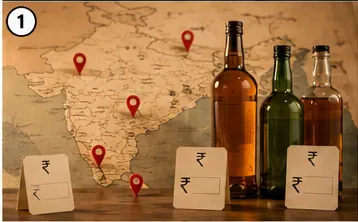
Alcohol pricing in India is local, so the same bottle can look very different from one city to another.
Why Alcohol Prices Change by City and State in India
A PourBud guide to why alcohol prices vary across Indian cities and states, including excise policy, MRP, pack size, stock, and local availability.
One of the most confusing things about alcohol in India is that the same bottle can have different prices in different cities. A whisky that looks expensive in one state may be cheaper in another. A beer can also change by pack size, stock cycle, category, or local tax structure. That is why PourBud treats city context as a core part of drink discovery.
India does not behave like one single alcohol market. Alcohol is regulated heavily at the state level, and states can follow different excise policies, taxes, retail rules, and pricing systems. This guide explains the practical reasons prices change, without pretending that one price is correct everywhere.
State policy is the biggest reason
Alcohol pricing is shaped by excise duty, license systems, state margins, levies, and policy changes. These rules are not identical across India. A state can revise tax slabs, change how alcohol strength is treated, alter retail margins, or adjust category-specific rules. When that happens, city prices can change even if the brand and bottle look the same.
This is why comparing a Goa price with a Mumbai, Delhi, Bangalore, Pune, or Gurgaon price can be misleading unless you include local context. The bottle name alone is not enough. The city and state matter.
MRP and retailer price are not always simple
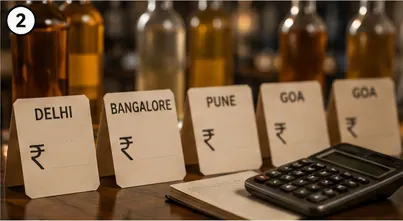
MRP gives a printed price context, but consumers may still see confusion because of old stock, updated policies, different pack sizes, or local retail handling. In some markets, a policy revision can affect new stock while older stock may still carry older printed labels. That can make the shelf feel inconsistent.
PourBud price pages should be read as discovery and comparison context, not as a legal guarantee or checkout price. Always verify with licensed local retailers and official/local sources where required.
Pack size changes the comparison
A 180 ml bottle, a 375 ml bottle, a 650 ml beer, a 700 ml whisky, and a 750 ml spirit are not directly comparable by sticker price. A lower price can simply mean a smaller pack. A larger pack can look expensive but may be different on a per-ml basis. ABV also matters because stronger drinks are not equivalent to lighter ones.
When you compare prices, check three fields together: category, volume, and city. This helps avoid the common mistake of comparing a 180 ml bottle in one city with a 750 ml bottle in another.
Availability also changes by city
Price is only one part of the story. Some products are listed in one state and not easily available in another. Distribution, local approvals, retailer stocking, category demand, and import rules can all influence what users see. A bottle may exist in India but not be visible in every city at the same time.
That is why a city-level page can be more useful than a generic product page. It helps you understand whether a drink has local price context and how it sits beside similar options in that market.
How PourBud users should compare prices
- Check the city before checking the price.
- Compare the same bottle size wherever possible.
- Read category and ABV before deciding value.
- Treat state price changes as normal, not as a website bug.
- Use product pages for discovery, then verify locally where required.
- Do not plan illegal transport or sourcing across state borders.
The practical takeaway
Alcohol prices change in India because alcohol rules are local. State policy, pack size, category, retailer stock, taxes, and availability all affect what a user sees. A good comparison does not ask only, “Which bottle is cheaper?” It asks, “Which city, which size, which category, which ABV, and which local context?”